Cloud Computing Security Risk Assessment Best Practices
Cloud computing security risk assessment helps you find and fix weaknesses before attackers do. This guide covers practical steps, common risks, and proven frameworks to keep your cloud environment safe. You will learn how to build a strong risk assessment framework and protect your data with confidence.
Key Takeaways
- Know your risks: A proper cloud computing security risk assessment reveals vulnerabilities in your cloud setup before they become costly problems.
- Follow a proven framework: Using structured steps like NIST or ISO 27001 makes your risk assessment process repeatable and reliable.
- Stay compliant: Regular assessments help you meet cloud compliance requirements and avoid legal trouble.
- Use the right tools: Automated vulnerability assessment tools save time and catch threats humans might miss.
- Involve your whole team: Security is everyone’s job, from IT staff to business owners.
- Keep improving: Cloud threats change fast, so your risk mitigation strategies must evolve too.
📑 Table of Contents
What Is Cloud Computing Security Risk Assessment?
Let us start with the basics. A cloud computing security risk assessment is the process of finding, analyzing, and ranking threats in your cloud environment. Think of it like a health checkup but for your digital systems. You want to know what could go wrong, how likely it is, and what damage it could cause.
Every business that uses cloud services faces risks. Whether you store customer data, run apps, or host websites in the cloud, there are always weak spots. A good risk assessment framework helps you spot those weak spots early. It gives you a clear picture of where you stand and what needs fixing first.
This process is not just for big companies. Small businesses and startups use it too. The truth is, every organization that moves to the cloud needs a plan. Without one, you are basically hoping nothing bad happens. And hoping is not a strategy.
So what does a full cloud threat assessment look like? It covers everything from data breaches to misconfigured servers. It checks your security vulnerabilities and measures how well your current cloud security controls are working. Let us dive deeper into why this matters so much.
Why Cloud Security Risk Assessment Matters
You might wonder why you need a formal assessment. Can you not just set up your cloud tools and hope for the best? The short answer is no. Here is why a structured cloud computing security risk assessment is essential.
First, cyberattacks are rising every year. Hackers are getting smarter. They target cloud environments because many companies do not secure them properly. A data breach can cost you money, customers, and your reputation. In fact, the average cost of a breach keeps climbing.
Second, regulations are getting stricter. Laws like GDPR, HIPAA, and PCI-DSS require businesses to protect data. If you fail a compliance check, the fines can be huge. Regular cloud compliance assessments help you stay on the right side of the law.
Third, cloud setups are complex. You might use multiple providers, different regions, and many services. Each one adds potential risks. A thorough risk analysis helps you understand this complexity and manage it well.
Real-World Impact of Ignoring Risk Assessment
Let us look at a quick example. A small online store moved its shop to the cloud. They did not perform any security assessment because they thought the cloud provider would handle everything. Within six months, a misconfigured database exposed customer credit card details. The business lost thousands in fines and never recovered its reputation.
This story is not rare. Many companies assume the cloud is automatically secure. But security is a shared responsibility. Your provider secures the infrastructure. You secure what is inside it. That includes your data, your apps, and your access controls.
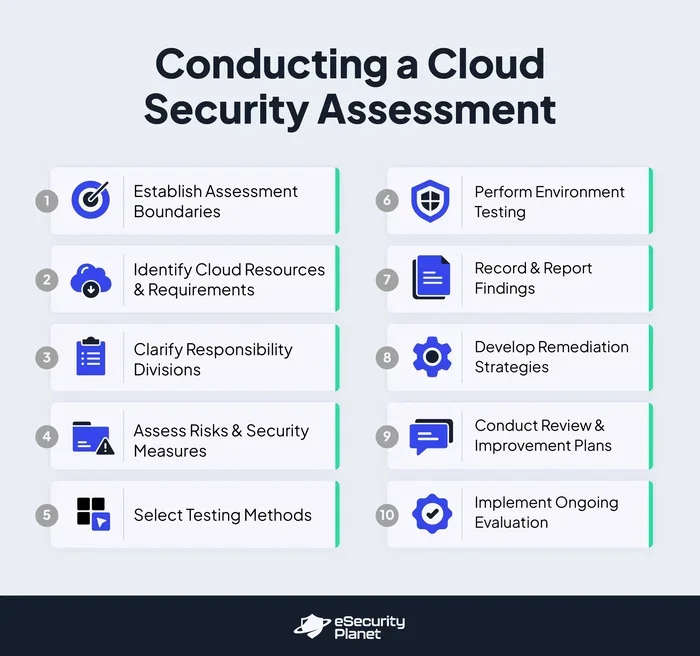
Key Steps in a Cloud Security Risk Assessment
Now let us get practical. How do you actually perform a cloud computing security risk assessment? Here are the steps that work for most organizations.
Step 1: Identify Your Assets
Start by listing everything you have in the cloud. This includes databases, applications, storage buckets, and virtual machines. You cannot protect what you do not know exists. Make a complete inventory of all your cloud infrastructure components.
Ask your team questions like:
- What data do we store in the cloud?
- Which applications run on cloud servers?
- Who has access to each resource?
- What third-party services connect to our cloud?
Step 2: Identify Threats and Vulnerabilities
Next, figure out what could go wrong. Look at common cloud security risks like unauthorized access, data leaks, and service outages. Also check for specific security vulnerabilities in your setup, such as open ports or weak passwords.
Use tools like vulnerability assessment scanners to automate this step. These tools scan your cloud environment and flag potential problems fast. They save hours of manual work and catch things you might overlook.
Step 3: Analyze and Rank Risks
Not all risks are equal. Some are deadly. Others are minor. You need to rank each risk based on two things: how likely it is to happen and how much damage it could cause. This is called risk analysis, and it helps you focus on what matters most.
Create a simple risk matrix. Put high-likelihood, high-impact risks at the top. Put low-likelihood, low-impact risks at the bottom. This way, you know exactly where to spend your time and money.
Step 4: Plan Your Risk Mitigation Strategies
Once you know your risks, create a plan to handle them. You have four main options:
- Avoid the risk: Remove the activity or feature that creates the risk.
- Reduce the risk: Add controls like encryption or access limits.
- Transfer the risk: Shift it to an insurance policy or a third party.
- Accept the risk: Acknowledge it and monitor it closely.
Most organizations use a mix of these approaches. The key is to have a clear plan for each major risk you found during your cloud threat assessment.
Step 5: Document and Review Regularly
Write everything down. Keep records of what you found, what you decided, and what actions you took. This documentation proves your due diligence if regulators ever ask questions.
Also, do not treat this as a one-time project. Cloud environments change constantly. New services get added. Old ones get removed. Set a schedule to repeat your risk assessment process at least every quarter. This keeps your security posture strong over time.
Common Cloud Security Risks You Should Know
Understanding the most common risks helps you focus your efforts. Here are the top threats that a cloud computing security risk assessment should always check for.
| Risk Type | Description | Impact Level |
|---|---|---|
| Misconfigured Storage | Open buckets or databases exposed to the internet | High |
| Weak Access Controls | Poor password policies or excessive user permissions | High |
| Data Breaches | Unauthorized access to sensitive customer or business data | Critical |
| Insecure APIs | Application interfaces that lack proper authentication | Medium |
| Insider Threats | Employees or contractors misusing their access | Medium |
| Compliance Failures | Not meeting regulatory requirements for data protection | High |
| Denial of Service Attacks | Overwhelming your cloud services to cause outages | Medium |
Each of these risks can hurt your business in different ways. Misconfigured storage is one of the top causes of data leaks. Weak access controls let attackers walk right through the front door. And compliance failures can lead to massive fines.
The good news is that most of these risks are preventable. A solid cloud security audit catches them early. You just need to know what to look for and how to fix it.
Quick Tips to Reduce Common Risks
- Always encrypt sensitive data, both in transit and at rest.
- Use multi-factor authentication for all user accounts.
- Limit access based on the principle of least privilege.
- Enable logging and monitoring on all cloud services.
- Review access permissions every month.
- Use automated tools to detect misconfigurations instantly.
Building a Risk Assessment Framework for the Cloud
A framework gives your cloud computing security risk assessment structure and consistency. Without one, assessments can be random and incomplete. With a framework, every assessment follows the same thorough process.
NIST Cybersecurity Framework
The NIST framework is one of the most popular choices. It has five core functions: Identify, Protect, Detect, Respond, and Recover. Each function maps directly to different parts of your risk management framework.
Many organizations love NIST because it is flexible. It works for small businesses and large enterprises alike. You can tailor it to fit your specific cloud setup and industry needs.
ISO 27001 Standard
ISO 27001 is an international standard for information security. It provides a systematic approach to managing sensitive data. Following ISO 27001 shows customers and partners that you take cloud data protection seriously.
The standard requires you to conduct regular risk assessments. It also asks you to document your risk mitigation strategies and review them often. This makes ISO 27001 a great choice for companies that need strong proof of their security efforts.
Cloud Security Alliance (CSA) STAR
The CSA STAR program focuses specifically on cloud security. It provides a registry of cloud providers and their security controls. If you work with third-party cloud vendors, checking their STAR status is a smart move.
Using a recognized framework gives your risk assessment process credibility. It also makes it easier to compare your results over time and share them with stakeholders.
How to Strengthen Your Cloud Security Posture
Assessment is only half the battle. Once you find risks, you need to act on them. Here is how to build a stronger cloud security posture over time.
Adopt a Zero Trust Approach
Zero trust means you trust no one by default. Every user, device, and connection must verify its identity before accessing resources. This approach dramatically reduces the chance of unauthorized access.
Implement zero trust by setting strict access rules. Require verification for every request, even from inside your network. This mindset shift changes how your team thinks about cloud infrastructure security.
Invest in Training and Awareness
Your people are your first line of defense. A well-trained team catches threats faster and makes fewer mistakes. Run regular training sessions on topics like phishing, password hygiene, and safe cloud usage.
Make security part of your company culture. When everyone understands cybersecurity assessment basics, they become active participants in keeping the business safe. This is far more effective than relying on tools alone.
Automate Where Possible
Manual processes are slow and error-prone. Use automated tools for vulnerability assessment, compliance checks, and monitoring. Automation catches issues in real time and frees your team to focus on bigger challenges.
Set up alerts for unusual activity. If someone tries to access a restricted database or downloads a large amount of data, you want to know immediately. Automated monitoring makes this possible without requiring a huge security team.
Partner with the Right Cloud Provider
Not all cloud providers offer the same level of security. Before you commit, ask tough questions. What security certifications do they hold? How do they handle data encryption? What is their incident response plan?
Review the cloud service agreement carefully. Make sure it clearly states who is responsible for what. A strong partnership with a security-focused provider makes your entire cloud computing security risk assessment much easier.
Conclusion
A cloud computing security risk assessment is not optional. It is a must-have for any business that uses cloud services. It protects your data, keeps you compliant, and builds trust with your customers.
Follow the steps outlined in this guide. Identify your assets. Find your risks. Rank them by impact. Plan your mitigation strategies. And review everything regularly. This process gives you confidence that your cloud environment is as secure as it can be.
Start today. Do not wait for a breach to make you care about cloud security. The time to assess your risks is before something goes wrong. Take control of your cloud computing security risk assessment and build a safer digital future for your business.
Frequently Asked Questions
What is the main goal of a cloud computing security risk assessment?
The main goal is to find weaknesses in your cloud setup before attackers do. It helps you understand your risks, rank them by severity, and create a plan to fix them. This process protects your data, keeps you compliant, and strengthens your overall security.
How often should you perform a cloud security risk assessment?
You should run a full assessment at least every quarter. However, if you make major changes to your cloud environment, you should assess right away. Regular reviews keep your risk mitigation strategies up to date and your security posture strong.
What tools are used for cloud security risk assessment?
Common tools include vulnerability scanners, cloud security posture management platforms, and compliance monitoring software. These tools automate much of the vulnerability assessment process and help you catch risks faster than manual checks alone.
Is cloud computing security the responsibility of the provider or the customer?
It is a shared responsibility. Your cloud provider secures the underlying infrastructure, but you are responsible for protecting your data, applications, and access controls. A proper cloud threat assessment clarifies exactly where your responsibilities lie.
Can small businesses benefit from cloud risk assessment?
Absolutely. Small businesses are often targeted because they lack strong security. A simple risk assessment framework helps small companies find and fix gaps without needing a large security team or big budget.
What is the difference between a risk assessment and a security audit?
A risk assessment focuses on finding and ranking potential threats. A security audit checks whether your controls meet specific standards or regulations. Both are important, and they work best when done together as part of a comprehensive cloud compliance strategy.